Contents
Whether you have just a few bottles or several cases, it’s vital to store them in the best possible conditions to avoid damaging the wine or allowing it to age too quickly.
The essential conditions for storing wine properly
To preserve bottles over the long term, it’s important to respect certain conditions that will prevent the wine from losing its aromas and spoiling too quickly.
First of all, the storage temperature must be cool and constant, preferably between 10 and 15°C. While wines cannot withstand too intense a temperature shock, slight variations are not harmful and, on the contrary, allow the wine to age gradually.
Bottles with corks should be stored horizontally, to keep the liquid in contact with the cork and prevent it from drying out, which could lead to accelerated evaporation and premature oxidation. Bottles with screw caps, on the other hand, can be stored upright without any problem.
To avoid the same problem of evaporation and oxidation of the wine, the humidity of the room must be maintained between 70 and 90% to guarantee the seal of the cork. Because of this humidity, a draught or ventilation is necessary to prevent unpleasant odors from developing. Any overly odorous elements that could have an adverse effect on the wine should also be avoided (vinegar, vegetables, chemicals, etc.).
It is also essential to keep the wine away from any vibrations and to handle it as little as possible to avoid the movement of deposits, which could eventually damage the wine.
Bottles must also be kept away from light, which can cause unpleasant cauliflower-like aromas to develop in the wine (the famous “light taste”). The color and thickness of the glass are important here, as dark, thick glass bottles are better protected than white ones.
Which wine cellar to choose?
Different solutions are available, depending on the space you have available and your budget.
In the case of traditional underground wine cellars, it’s vital to ensure that all the conditions described above are met. The ideal solution is to equip the cellar with tools such as a thermometer and hygrometer to check that the correct temperature and humidity levels are maintained. Bright lights, such as neon, should also be avoided; it’s better to use soft lighting (such as LEDs) and, if necessary, wrap the most fragile bottles in tissue paper to prevent them coming into direct contact with the light. In addition, to avoid having to handle bottles excessively, good cellar management is important. Organizing bottles by region, with clearly visible labels, in storage racks, and keeping a paper or electronic register, makes it easier to find your way around and avoids having to search too long for a wine by moving other bottles.
If you don’t have a natural cellar, or if your cellar is too small or unsuitable for storing wine, but you still want to keep a large quantity of bottles, you can call on specialists who offer to store your wines in their own cellars. Several companies offer this service in Paris and other major cities, and generally operate on a monthly or annual basis. Note that for cellar connectivity, you may need to have a wifi network available, or in rare cases, a sim card with a cheap inexpensive data package may suffice.
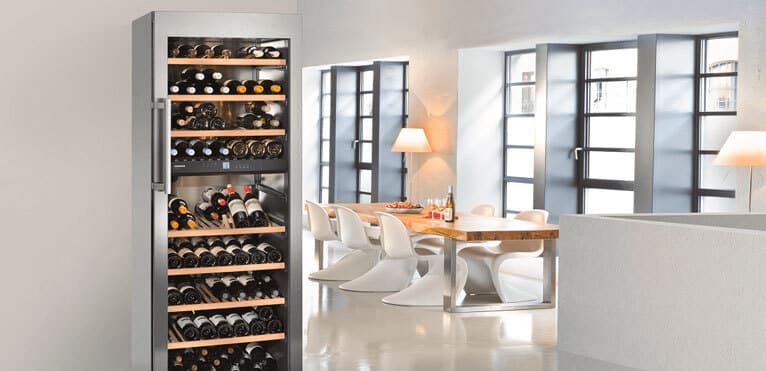
Finally, to store smaller quantities of bottles, you can install an electric wine cellar in your home. There are two main categories: ageing cellars and service cellars. The former recreate the conditions of a natural cellar, with temperature and humidity automatically maintained at an ideal level to enable bottles to be preserved and aged over the long term. Service cellars, on the other hand, are better suited to wines that need to be drunk quickly. Some even allow you to vary the temperature on different levels, so you can distinguish between wines according to their ideal serving temperature. Whatever the category, they come in a wide range of prices and capacities, as well as noise levels and power consumption.
There are many criteria to take into account when choosing a wine cellar: number of bottles to be stored, conservation objective (simple storage or the desire to age wines), budget, available space… The most important thing is to respect the fundamental principles to avoid damaging your wines and finding yourself disappointed when opening a bottle.
All that’s left is to build up your wine cellar!
Photo : Liebherr



Related articles




The online wine market is still expanding in 2024, offering consumers a wide choice at competitive prices, even if it…